Kueh Pie Tee
kueh pie tee
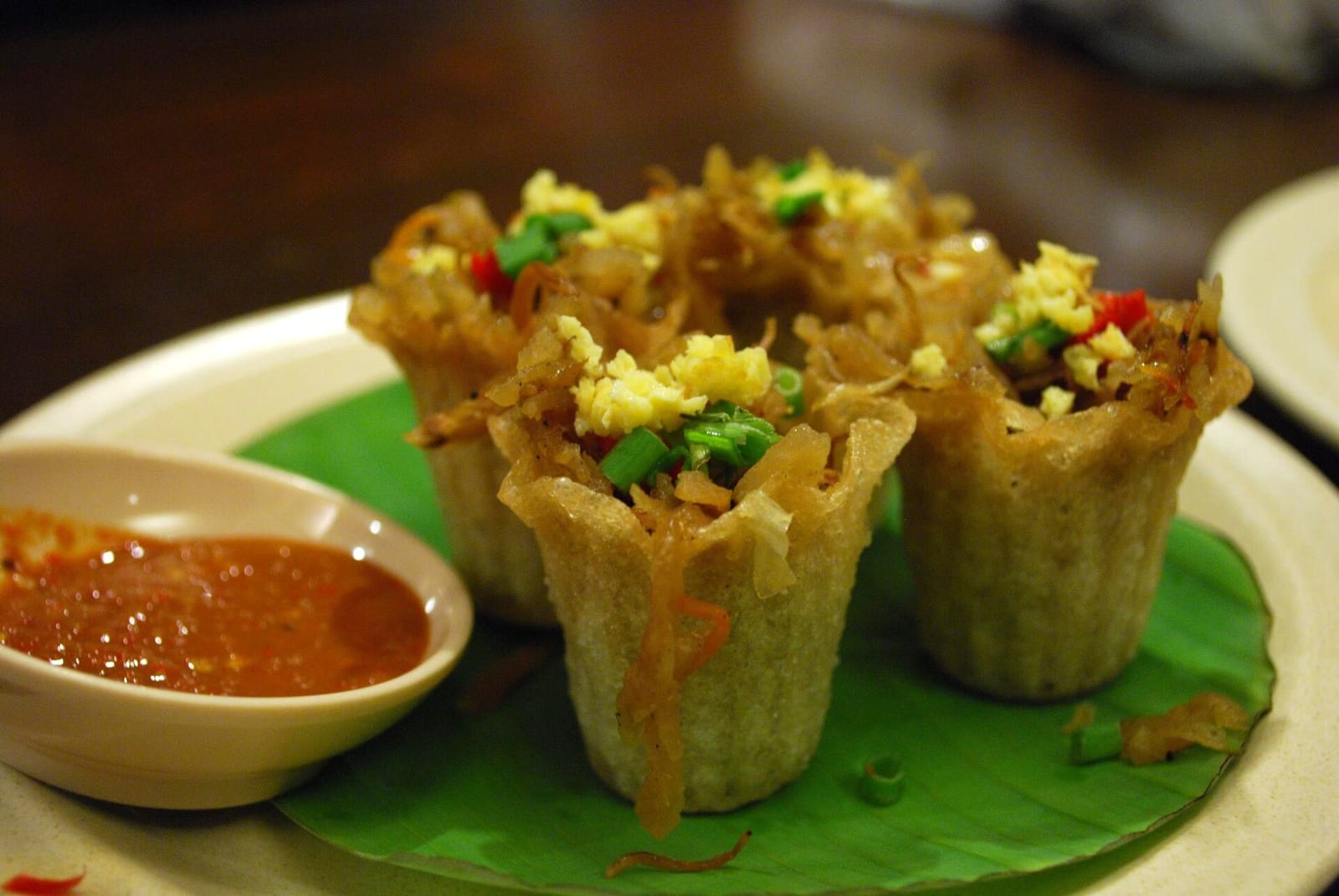
Nyonya top hats — crisp fried cups filled with braised bangkwang and bamboo shoot, crowned with prawn and chili, gone in one bite at every party.
By The Singaporean Recipes Kitchen · World Cookbook Series · July 21, 2026
Katong–Joo ChiatStreet hawkers & the kampong, 1900s–1942
.jpg)
- Prep
- 50 min
- Cook
- 40 min
- Serves
- 6
- Level
- Intermediate
Some dishes are engineered for a plate; kueh pie tee is engineered for a party. It is a crisp little fried cup — a top hat, everyone calls it — filled with a warm braise of shredded bangkwang and bamboo shoot and crowned with a prawn, a scatter of egg, a coriander leaf, a dot of chili. You eat it in one bite, and then you eat another, and the tray is empty before the host has sat down. It exists to be made in volume, by hand, in a kitchen full of people who are also talking.
That communal assembly is the soul of it. The shells are cast one at a time on a little brass mould dipped in batter and lowered into hot oil, a rhythm that has aunties working in relay while someone else shreds cucumber and someone else halves prawns. It grew up in the Straits-Chinese households of Katong and Joo Chiat and on the hawker plates of the same neighbourhoods, festive food for open houses and reunions, the kind of thing you learn standing next to someone who already knows. Where the name comes from, nobody can honestly say — the shape earned the English nickname, and the rest is lost in a hundred good afternoons.
The one law of pie tee is timing. A filled shell is crisp for a matter of minutes before the braise's moisture creeps in and softens it to sadness, which is why the assembly happens at the table, in front of the people eating it — not out of showmanship but out of physics. Everything can be prepped ahead: the shells fried and stored airtight, the filling braised and cooled, the garnishes lined up in little bowls. The shells go together at the last possible second, and the reward for that discipline is the specific pleasure of biting through a shatter into something warm and sweet and savoury at once. That contrast is the dish. Assemble early and you have thrown it away.
A top hat is only crisp for a minute, so you fill it in front of your guests. That impatience is the whole ceremony.
Shiok (when it's exactly right) · A word from the kitchen
Ingredientsbahan-bahan
Serves
The shells
- 100 gplain flour (about 3/4 cup)
- 30 grice flour (about 1/4 cup)the rice flour is what makes the shell shatter rather than bend — do not swap it all for wheat
- 1egg
- 250 mlwater (about 1 cup)
- 1/4 tspsalt
- enough to deep-fryneutral oilyou also need a pie tee mould — the little brass top-hat iron; nothing else makes this shape
The braised filling
- 500 gbangkwang (jicama / yam bean), peeled and cut into fine matchsticks (about 1 lb)this is the body of the filling — crisp and faintly sweet; a food processor shred is honest here
- 150 gcanned bamboo shoots, rinsed well and finely julienned (about 5 oz)rinse until the tinny smell is gone, or it will haunt the whole plate
- 1carrot, finely julienned
- 150 gsmall prawns, peeled and roughly chopped (about 5 oz)
- 3garlic cloves, minced
- 1 tbsptaucheo (fermented soybean paste), mashed
- 2 tbspneutral oil
- 1 tspsugar
- to tastewhite pepper and salt
To crown each one
- 150 gprawns, cooked and halved lengthwise (about 5 oz)
- 2eggs, made into a thin omelette and shredded
- 1cucumber, seeded and finely shredded
- 3 tbspfried shallots
- 1red chili, finely sliced
- 1 small bunchcoriander leaves
- to servesweet chili-garlic saucea Nyonya table often puts out a chili-lime sauce too — sharp against the sweet filling
Methodcara masak
Step 1: Braise the filling first, and cool it
Soften the garlic in oil, fry the taucheo for a minute, then add the prawns until they just turn pink. Add the bangkwang, bamboo shoot, and carrot, season with sugar, salt, and white pepper, and braise uncovered over medium heat for 20 to 25 minutes until the bangkwang is tender and translucent and — this is the part that matters — most of the liquid has cooked away. A wet filling turns a crisp shell soggy in seconds. Spread it on a tray to cool completely.
Step 2: Make the batter and rest it
Whisk the plain flour, rice flour, salt, egg, and water into a smooth batter a touch thinner than pancake batter, then let it rest 20 minutes. Resting relaxes the flour so the shells fry up crisp instead of tough. It should coat a spoon in a thin, even film — too thick and your top hats come out clumsy and heavy.
Step 3: Heat the mould, then the oil
Heat the oil to about 180C (350F) and sit the pie tee mould in it to heat through for a full two minutes. This is the whole trick — a cold mould sheds the batter and a screaming one burns it. The mould has to be hot enough that the batter sizzles on contact and clings.
Step 4: Cast the shells
Lift the hot mould, dab off excess oil, then dip it into the batter to just below the rim — never over the top, or the shell seals into a ball you cannot fill — and lower it straight back into the oil. After a few seconds the shell sets and slips off the mould on its own; if it clings, a gentle shake frees it. Fry each shell until pale gold and crisp, about a minute, and drain upside down on a rack. Re-heat the mould in the oil between every single shell.
Step 5: Assemble at the last possible moment
These go together only when guests are in the room, because a filled top hat stays crisp for minutes, not hours. Spoon warm filling into each shell, then crown it — a half prawn, a pinch of shredded egg and cucumber, fried shallots, a sliver of chili, a coriander leaf, and a dot of sweet sauce. Serve immediately, and expect them to vanish faster than you can plate them.
Perkakas · The tools
Equipment
Carbon-steel wok
chaoHalf this site happens in a wok, and carbon steel is the only honest choice at home — it heats fast, takes a season, and gets you the closest to wok hei your burner allows.
Shop on Amazon →Spider strainer
Lifts blanched noodles out of the pot in one pass and fried shallots out of the oil in the next. One tool, half the hawker canon.
Shop on Amazon →Frying thermometer
The difference between shattering har cheong gai and greasy har cheong gai is oil held at temperature — stop guessing.
Shop on Amazon →
Equipment links are Amazon affiliate links. As an Amazon Associate we earn from qualifying purchases, at no cost to you. Disclosure.
Rate this recipe
Questions from the kitchen
Why are they called top hats?
Because that is exactly what the little fried shell looks like — a brim and a crown, a gentleman's hat shrunk to two bites. The English nickname stuck for the obvious reason. Where the name "pie tee" itself comes from is murkier, and anyone who tells you the definitive origin with a straight face is guessing; the honest answer is that it entered the Nyonya and wider Straits repertoire as a party piece and the etymology got lost in the good times. What is not in dispute is its role: this is celebration food, made in a production line by aunties while the kitchen gossips.
My shells came out thick, greasy, or stuck to the mould. Where did I go wrong?
Almost always the mould temperature. It has to be properly hot before each dip, which means returning it to the oil between shells — skip that and the batter refuses to cling or slides off in a lump. Greasy, heavy shells usually mean the oil dropped too low; keep it steady around 180C. And if the batter climbs over the top rim of the mould, the shell seals shut instead of forming a cup, so dip to just below the edge every time.
Can I just buy the shells?
Yes, and plenty of very good Nyonya cooks do exactly that. Ready-made pie tee shells are sold in tubs at Asian groceries, and on a day when you are also braising the filling, frying an omelette, and prepping six garnishes, buying the shells is not cheating — it is triage. What you cannot outsource is the filling and the discipline of assembling at the last minute. Buy the shells if you must; just never fill them early.
Makan lagi · Cook next
Keep the burner on
 04
04The Peranakan Table·70 min·Beginner
Nonya Chap Chyechap chye
The everyday Peranakan braise — Chinese cabbage cooked soft in taucheo with lily buds, wood ear, and glass noodles, the quiet side that steals a feast.
 04
04The Peranakan Table·210 min·Advanced
Ayam Buah Keluakayam buah keluak
The Peranakan benchmark — chicken braised in tamarind gravy with buah keluak, the toxic nut that three days of soaking turns into black, truffle-dark gold.
 04
04The Peranakan Table·135 min·Intermediate
Babi Pongtehbabi pongteh
Pork shoulder and shiitake braised slow with taucheo and gula melaka — the brown, bubbling everyday stew at the heart of the Straits-Chinese kitchen.