Tau Sar Piah
豆沙饼
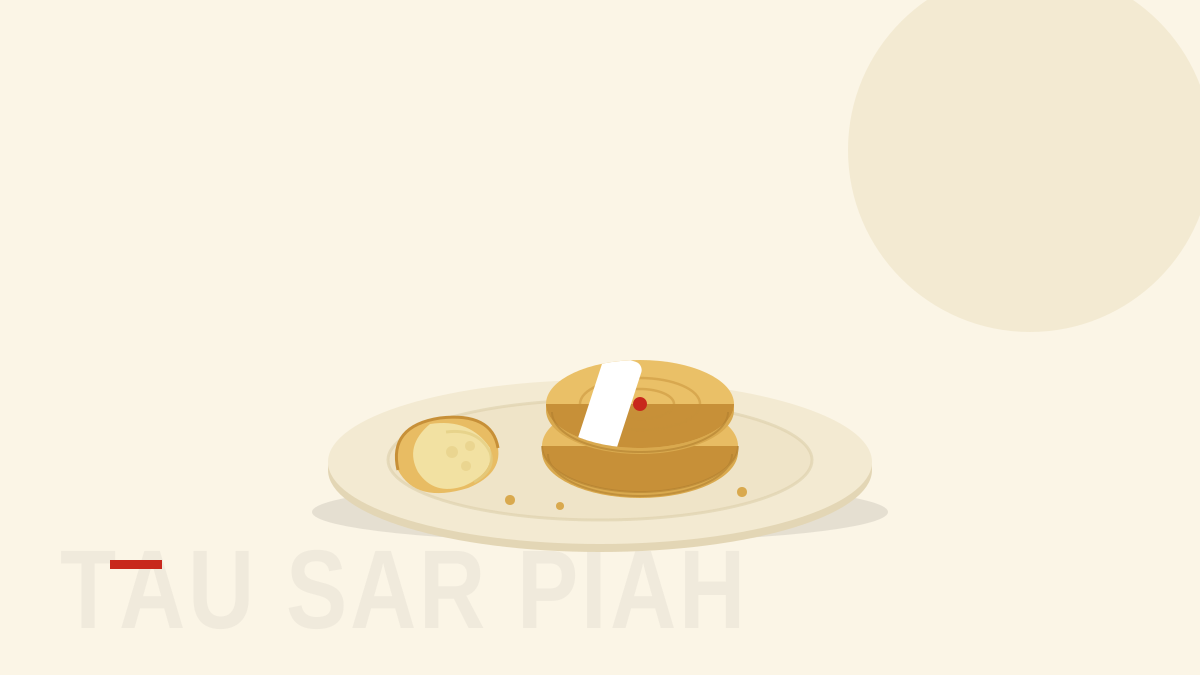
Balestier's shophouse pastry — flaky spirals of water dough and oil dough wrapped around fried mung bean paste, sweet or salted, worth every rest.
By The Singaporean Recipes Kitchen · World Cookbook Series · June 29, 2026
Balestier & WhampoaStreet hawkers & the kampong, 1900s–1942
 08
08- Prep
- 100 min
- Cook
- 60 min
- Serves
- 16
- Level
- Advanced
Balestier Road is the only street in Singapore where a pastry has an address. The strip of shophouse bakeries along it has been turning out tau sar piah for generations — palm-sized rounds of shattering flaky pastry around a dense fried mung bean heart, sold warm by the dozen in paper bags that go translucent with lard before you reach the bus stop. The technique came south with Fujianese bakers; the street made it a pilgrimage. Regulars split on a single question, asked at every counter: sweet or salty?
Take the question seriously, because it is the dish's best idea. The sweet filling is what you expect — mung beans fried with sugar and lard into something like a fudge. The salted one is the sleeper: the same beans cut with salt, white pepper, and crushed fried shallots, so the pastry eats like a savory biscuit with a whisper of sweetness left in the bean itself. Bakeries mark the difference with sesame on the sweet and bare tops on the salted, a labelling system older than any printed sticker on the road.
The pastry itself is Chinese lamination — a cousin of the spiral-skin mooncake, and a completely different animal from French puff. Instead of folding butter into one dough, you make two doughs: a supple water dough that builds gluten, and an oil dough of nothing but flour and fat that cannot. Wrap one in the other, roll it out and roll it up, twice, and you have sheets of structure alternating with sheets of fat that refuse to merge. In the oven the fat melts, steam pushes the flour sheets apart, and the shell sets into layers fine enough to fall like ash. None of this is difficult the way wok hei is difficult; it is difficult the way patience is difficult. The recipe is mostly rests, and every one you skip gets collected from you at the oven door.
We give this recipe an honest Advanced — not for any single step, but because lamination punishes improvisation and the first batch teaches you things the instructions cannot. The Balestier bakers get it right at volume, before dawn, over charcoal-heated ovens in living memory. You get a home oven, a quiet morning, and sixteen chances per batch. That is a fair trade.
Two doughs, one with water and one without — rolled together they cannot mix, and that refusal is what shatters in your hand outside the bakery.
Shiok (when it's exactly right) · A word from the kitchen
Ingredientsbahan-bahan
Serves
The filling
- 250 gpeeled split mung beans, soaked 3 hours (about 1¼ cups)the yellow ones, already skinned — whole green mung beans mean an afternoon of peeling you did not sign up for
- 90 gcaster sugar (about 7 tbsp)for the sweet half of the batch; hold back 30 g of it if you are making all salted
- 1 tspfine salt
- ½ tspground white pepperthe salted version's signature — with the fried shallots, it is the reason Balestier regulars order salty over sweet
- 2 tbspcrisp fried shallots, lightly crushedfor the salted half only
- 70 glard or shortening (about 5 tbsp)lard is the shophouse standard and it shows in the flavor; shortening works and keeps the pastry vegetarian — this is a real choice, not a footnote
The water dough
- 150 gall-purpose flour (about 1 cup + 2 tbsp)
- 20 gcaster sugar (1½ tbsp)
- 45 glard or shortening, at cool room temperature (about 3 tbsp)
- 60 mlwater, room temperature (¼ cup)
The oil dough
- 120 gcake flour or all-purpose flour (about 1 cup)
- 60 glard or shortening, at cool room temperature (about 4 tbsp)the two doughs must feel the same softness in the hand — if the oil dough is squishier, chill it ten minutes before laminating
To finish
- 1egg yolk, beaten with 1 tsp water
- 1 tbspwhite sesame seeds
Methodcara masak
Step 1: Steam the beans
Drain the soaked mung beans and steam them in a thin layer for 25 minutes, until a bean crushes to powder between two fingers with no hard heart. Steaming rather than boiling matters — boiled beans drink water you will only have to fry back out later, and a wet paste is the enemy of a sealed pastry.
Step 2: Fry the paste
Mash or blitz the hot beans to a fine crumb, then fry them in a wok over medium-low with the lard, sugar, and salt, pressing and turning for 10 to 15 minutes. It is done when the paste stops steaming, darkens a shade, and pulls away from the wok in one mass that holds a fingerprint. Split the batch — leave half sweet, and work the white pepper and fried shallots into the other half. Cool completely, then roll into 16 balls of about 28 g each. Warm filling will melt the lamination from the inside; do not rush this.
Step 3: Make two doughs that match
Work the water dough ingredients into a smooth, supple ball — knead a full five minutes, because this dough needs enough gluten to stretch around everything without tearing. Mix the oil dough just until it comes together like marzipan; kneading it does nothing, there is no water in it to build gluten. Divide each dough into 16 balls, cover, and rest 15 minutes. The rest is not optional — unrested water dough snaps back when rolled and tears over the filling.
Step 4: Laminate, twice
Flatten a water-dough ball, wrap it around an oil-dough ball, and seal. Roll it into a tongue the length of your hand, then roll it up from the short end like a carpet. Turn it 90 degrees, roll it long again, and roll it up a second time. Rest all 16, seam down and covered, 15 minutes. This is the entire architecture of the pastry — each roll-up multiplies the alternating sheets of gluten dough and pure fat, and the fat sheets are what keep the flour sheets apart in the oven. Skip the second roll or the rests and you bake a cookie, not a piah.
Step 5: Fill and seal
Press each spiral flat with your thumb, bringing the two cut ends together, and roll to a palm-sized round, thicker in the centre than the edge — the centre carries the base, the thin edge gathers without bulk. Wrap around a ball of filling, pleat and pinch firmly closed, and set seam-down on a lined tray. A lazy seal opens in the oven and the filling caramelizes onto your tray instead of staying in the pastry.
Step 6: Bake
Brush the tops with egg yolk, scatter sesame over the sweet ones (the shophouse convention — plain tops mark the salted, so you know before you bite), and bake at 180°C (350°F) for 22 to 26 minutes until deep gold. Done means the sides show faint rings of separated layers and a pastry lifts off the paper cleanly and feels light for its size. Cool 15 minutes; straight from the oven the filling is lava.
Perkakas · The tools
Equipment
Bamboo steamer
Chwee kueh, pau, and whole fish — bamboo breathes, so condensation never rains back onto your work.
Shop on Amazon →Carbon-steel wok
chaoHalf this site happens in a wok, and carbon steel is the only honest choice at home — it heats fast, takes a season, and gets you the closest to wok hei your burner allows.
Shop on Amazon →Chinese cleaver
chai daoChops through a whole chicken for chicken rice, smashes ginger with the flat, scoops the lot into the wok. One blade, most of the canon.
Shop on Amazon →
Equipment links are Amazon affiliate links. As an Amazon Associate we earn from qualifying purchases, at no cost to you. Disclosure.
Rate this recipe
Questions from the kitchen
Every Balestier bakery claims to be the original. Who actually is?
Balestier Road has been the tau sar piah street for generations — a strip of shophouse bakeries, several with "since" dates painted proudly on the glass and at least two with a family feud baked into the signage. We are not walking into that one. The honest history is that the pastry came south with Fujianese bakers, the technique is older than any shop on the road, and the street itself — not any single till — is the institution. Buy from whichever queue smells best.
My pastry baked up dense, with no layers. What happened?
The layers die three ways. The doughs did not match — if the oil dough is softer than the water dough, it smears instead of sheeting, so chill it until they feel identical. The rests got skipped — tense gluten tears during rolling, and every tear welds two layers together. Or the filling was warm when you wrapped, melting the fat sheets from inside. Match, rest, cool. All three, every time.
Can I use store-bought red bean paste instead of making the mung filling?
You can wrap anything in this pastry and it will be structurally fine — but then you have made a different pastry, closer to a Teochew crisp-skin bun. Tau sar in this dish means mung bean, and the salted version, cut with white pepper and fried shallots, is the one that does not exist in a can. If you only have energy for one shortcut, buy the fried shallots, never the filling.
Makan lagi · Cook next
Keep the burner on
 08
08Kueh & Sweets·110 min·Intermediate
Min Jiang Kueh面煎粿
A thick, honeycombed griddle pancake folded over a heap of crushed sugared peanuts — the unhurried morning-market kueh that rewards a slow batter and a patient pan.
 08
08Kueh & Sweets·55 min·Intermediate
Ondeh Ondehondeh ondeh · onde-onde
Pandan-green glutinous balls rolled in fresh coconut, each hiding a core of gula melaka that bursts across the tongue — the reason the kueh exists.
 08
08Kueh & Sweets·115 min·Advanced
Kueh Salatkueh salat · seri muka
Seri muka, the beautiful face — a firm layer of coconut glutinous rice under a smooth pandan custard, the two-tone kueh that Malay and Nyonya kitchens claim.