Kueh Salat
kueh salat · seri muka
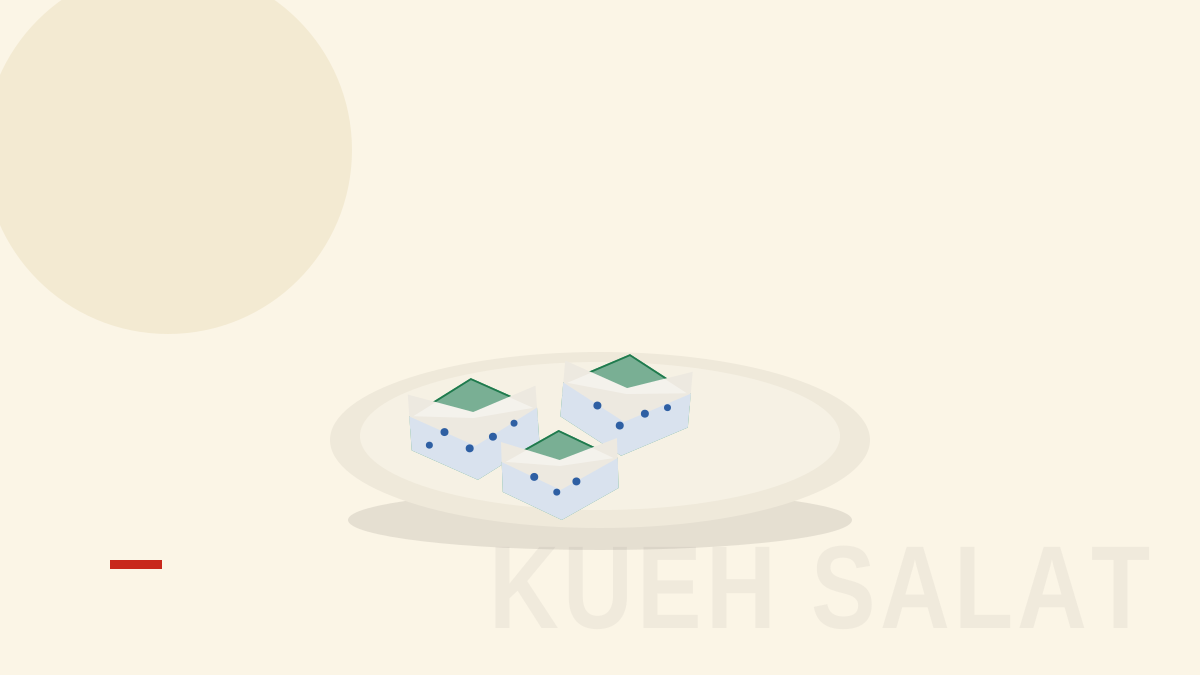
Seri muka, the beautiful face — a firm layer of coconut glutinous rice under a smooth pandan custard, the two-tone kueh that Malay and Nyonya kitchens claim.
By The Singaporean Recipes Kitchen · World Cookbook Series · July 22, 2026
Katong–Joo ChiatStreet hawkers & the kampong, 1900s–1942
 08
08- Prep
- 40 min
- Cook
- 75 min
- Serves
- 9
- Level
- Advanced
Kueh salat is a test disguised as a dessert. Two layers — a firm bed of coconut glutinous rice below, a smooth pandan custard above — and everything about whether it works lives in details you cannot see until you cut it open. Get them right and you have a clean green-over-white square that gleams; get them wrong and you have a slumped, pockmarked, weeping thing that tastes fine and looks like a confession. There is a reason the Malay name is seri muka, "beautiful face." The face is the grade.
It is a dish with two homes and two names, and both deserve credit. Across Malay kitchens it is seri muka, a staple of the kueh tray at gatherings and festive days. In the Peranakan households of Katong and Joo Chiat it is kueh salat, folded into a Nyonya kueh culture that treated these two-tone sweets as an art form. Neither community borrowed it from the other so much as both carried it forward — the shared inheritance of a region where Malay and Straits-Chinese kitchens cooked side by side for generations. To tell its story as belonging to only one is to miss how this food actually came to be.
The technique is where an advanced kueh separates from a passable one, and it comes down to two disciplines. Real pandan juice — leaves blended and wrung out, not paste from a bottle — is non-negotiable, because that grassy, faintly vanilla perfume is the entire character of the top layer and no shortcut fakes it. And low, patient steam is what sets the custard smooth; the moment you steam it too hard, air and water beat their way in and leave the surface spongy and cratered. Press the rice firm while it is hot, pour the custard through a sieve, keep the flame low, wrap the lid against dripping condensation, and then — the hardest part — wait. Let it cool completely before you cut. A warm kueh salat tears every time. The beautiful face belongs only to the cook with the patience to earn it.
A beautiful face is earned, not poured. The custard sets smooth only for the cook patient enough to keep the steam low.
Shiok (when it's exactly right) · A word from the kitchen
Ingredientsbahan-bahan
Serves
The rice base
- 300 gglutinous rice, soaked at least 4 hours or overnight (about 1 1/2 cups)the long soak is not optional — unsoaked grains steam unevenly and the base sets patchy and hard
- 150 mlcoconut milk (about 2/3 cup)
- 1/2 tspsalt
- 2pandan leaves, knotted
- 1 tbspdried butterfly pea flowers (bunga telang), optionalsteeped in a little hot water, their indigo tints a handful of grains blue — the classic freckled look, purely for beauty
The pandan custard
- 15pandan leaves, for fresh juicereal pandan juice is the whole dish — bottled paste reads flat and fake green; there is no honest shortcut here
- 150 mlwater, to blend the pandan (about 2/3 cup)
- 4eggs
- 200 gsugar (about 1 cup)
- 250 mlcoconut milk (about 1 cup)
- 40 gplain flour (about 1/3 cup)
- 20 grice flour (about 2 1/2 tbsp)the two flours together set the custard soft but sliceable — too much and it turns rubbery, too little and it weeps
- 1/4 tspsalt
Methodcara masak
Step 1: Press the pandan for real juice
Snip the 15 pandan leaves, blend with the water to a rough green pulp, then wring it hard through a muslin or fine sieve. You want the thick, dark-green liquid — let it stand and the deepest colour settles to the bottom; that concentrated layer is what gives a true pandan custard its jade tone and its grassy-vanilla smell. Set it aside; the flavour is fragile, so make it near the end of the prep.
Step 2: Steam the rice base and press it firm
Drain the soaked rice, toss it with the coconut milk, salt, and knotted pandan (streak in a spoon of the blue butterfly-pea water through a few grains if you like the freckled look), and steam over rapid heat for 25 to 30 minutes until the grains are tender and glossy, stirring once halfway so they cook evenly. While it is still hot, tip it into a lined, greased tin and press it down hard and flat with a banana leaf or the back of a spoon. Pressing firmly is what keeps the two layers from sliding apart later — a loose base and the custard sinks into it.
Step 3: Cook the custard to the ribbon stage
Whisk the eggs, sugar, coconut milk, pandan juice, both flours, and salt until completely smooth, then strain to catch any lumps. Cook it in a double boiler or heavy pan over low heat, stirring constantly, until it thickens just enough to coat the back of a spoon and hold a faint ribbon — a few minutes, no more. Do not chase a thick pudding here; you only want to give it a head start so it steams smooth instead of splitting. Stir the whole time, because custard scrambles at the edges the moment you look away.
Step 4: Pour, then steam low and slow
Pour the warm custard gently over the pressed rice through a sieve, so it lands even and lump-free. Steam over the lowest possible heat for 40 to 45 minutes. Low heat is everything — a hard steam blows holes and pockmarks in the surface and turns the custard spongy. Wrap the lid in a cloth to catch condensation so no water drips onto the top and scars it. It is done when the surface is set with only the faintest jiggle at the centre and a skewer comes out clean.
Step 5: Cool completely before you dare cut
This is where impatience ruins a good kueh. Let it cool to room temperature and then chill for at least two hours, until fully firm, before slicing. Warm kueh salat tears and smears — the custard has to set all the way through to cut into clean two-tone squares. Use a lightly oiled knife, wiped between cuts, and you get the sharp green-over-white slices the dish lives or dies on.
Perkakas · The tools
Equipment
Bamboo steamer
Chwee kueh, pau, and whole fish — bamboo breathes, so condensation never rains back onto your work.
Shop on Amazon →Granite mortar & pestle
lesung batuThe rempah tool. Pounding bruises and bleeds the aromatics in a way blades never do — the lesung is the sound of a Singapore kitchen starting dinner.
Shop on Amazon →Chinese cleaver
chai daoChops through a whole chicken for chicken rice, smashes ginger with the flat, scoops the lot into the wok. One blade, most of the canon.
Shop on Amazon →
Equipment links are Amazon affiliate links. As an Amazon Associate we earn from qualifying purchases, at no cost to you. Disclosure.
Rate this recipe
Questions from the kitchen
Is it kueh salat or seri muka — and whose dish is it?
It is both names for the same two-layer kueh, and it belongs to two kitchens at once. "Seri muka" is Malay for "beautiful face," a fair description of that smooth green top, and the dish is a fixture of Malay kueh trays across the region. It is equally at home in the Peranakan repertoire, where the Nyonyas made it part of their own kueh culture. Both claims are real and neither cancels the other — this is a shared Malay-Peranakan sweet, and the honest thing is to credit both rather than quietly adopt it for one side.
The two layers slid apart, or the custard came out spongy and full of holes. What went wrong?
The sliding is a pressing problem — the rice base has to be packed down hard while still hot so the custard sits on a firm foundation instead of sinking in. The holes and sponginess are a heat problem: you steamed the custard too hot. Custard sets smooth only over very low, gentle steam; a rolling, aggressive steam whips air and water into it and leaves it pocked and rubbery. Keep the flame low and wrap the lid so condensation cannot rain onto the surface.
Can I use pandan paste or extract instead of juicing all those leaves?
You can, and it will look the part, but this is one of the few places we will tell you plainly that the shortcut costs you the dish. Real pandan juice carries a grassy, almost vanilla perfume that bottled paste simply does not have — paste gives you a loud artificial green and a flat taste. If fresh pandan is genuinely unavailable, frozen whole leaves blitzed for juice are a fair second. Extract is a last resort, and a kueh made with it is a kueh making apologies.
Makan lagi · Cook next
Keep the burner on
 08
08Kueh & Sweets·55 min·Intermediate
Ondeh Ondehondeh ondeh · onde-onde
Pandan-green glutinous balls rolled in fresh coconut, each hiding a core of gula melaka that bursts across the tongue — the reason the kueh exists.
 08
08Kueh & Sweets·110 min·Intermediate
Min Jiang Kueh面煎粿
A thick, honeycombed griddle pancake folded over a heap of crushed sugared peanuts — the unhurried morning-market kueh that rewards a slow batter and a patient pan.
 08
08Kueh & Sweets·160 min·Advanced
Tau Sar Piah豆沙饼
Balestier's shophouse pastry — flaky spirals of water dough and oil dough wrapped around fried mung bean paste, sweet or salted, worth every rest.