Hainanese Chicken Rice
海南鸡饭
A whole bird poached to silk at a sub-boil, rice fried in its fat and cooked in its stock, three sauces standing by — the island's quietest masterpiece.
By The Singaporean Recipes Kitchen · World Cookbook Series · June 21, 2026
Chinatown & MaxwellPostwar & Merdeka, 1945–1965
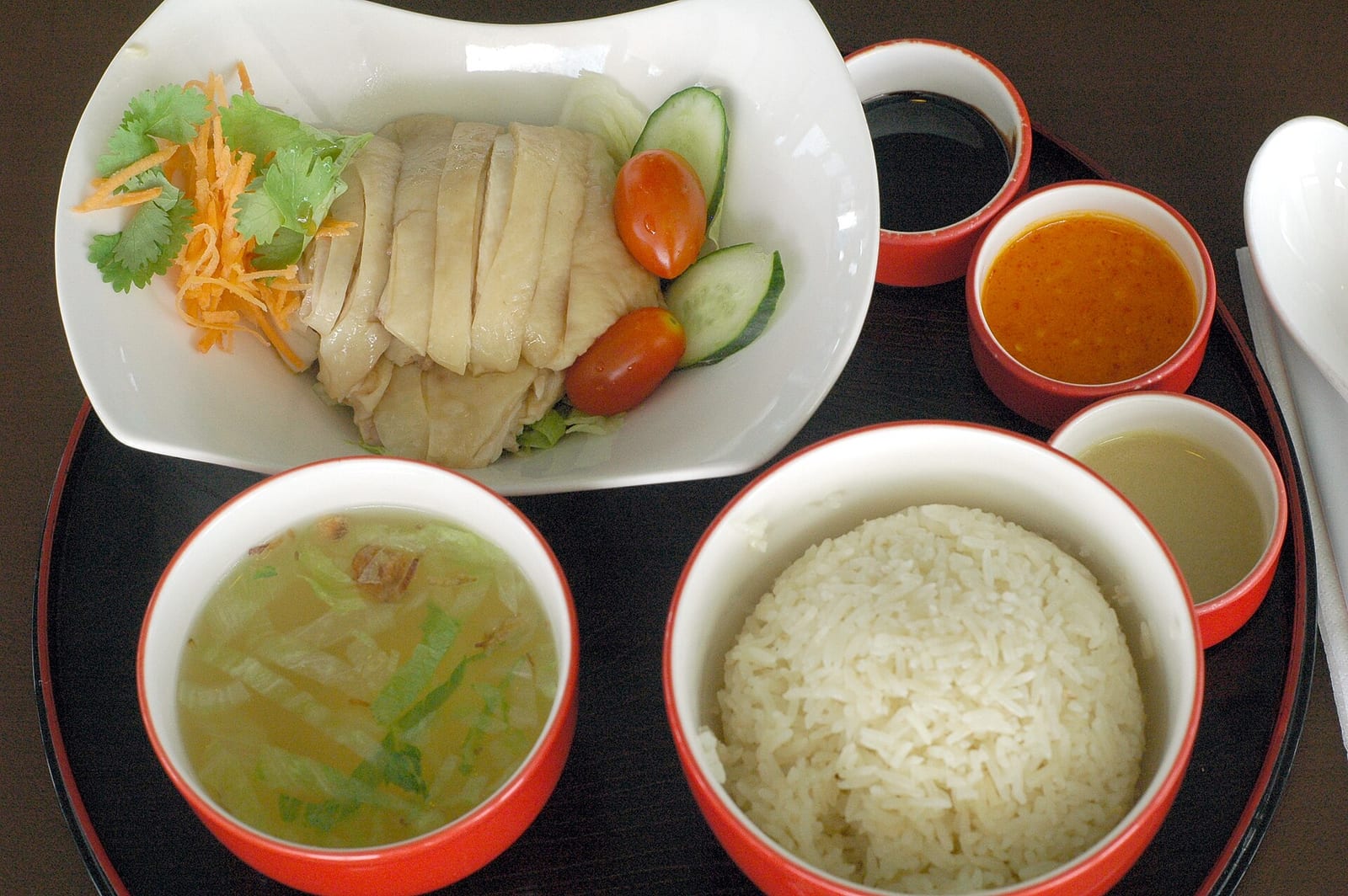

- Prep
- 40 min
- Cook
- 60 min
- Serves
- 4
- Level
- Intermediate
There is a case to be made — and it has been made, loudly, across two national borders — that this is the most important plate of food in Singapore. It looks like nothing. Pale chicken, white rice, a saucer of chili, cucumber that no one asked for. The entire dish operates below the frequency of spectacle, which is exactly why it is the sternest test in the hawker repertoire: there is nowhere to hide. No char, no gravy, no crunch. Just whether you can poach a bird and cook a pot of rice better than the stall across the aisle.
The technique came from Wenchang, on the island of Hainan, where poached chicken served with rice cooked in its fat was already an old idea. Hainanese immigrants arrived in the Straits later than the Hokkiens and Cantonese, found the good trades taken, and moved into the one space left open — cooking, first in British colonial households and coastal kopitiams, then for everyone. The dish they carried became naturalized. By 1949, when Swee Kee opened on Middle Road, chicken rice was on its way from immigrant memory to civic institution, and the postwar decades finished the conversion. Today the queue outside a great chicken rice stall — Maxwell Food Centre has a famous one — functions as public infrastructure, a lunchtime referendum held daily.
Malaysia, it should be said plainly, has its own claim and its own lineages, and the periodic cross-Causeway shouting match over ownership is best understood as two countries agreeing the dish matters. The Hainanese brought the technique; the region built the shrine; arguing over the deed to a temple everyone prays in seems beside the point.
What you need to know as a cook is that the name is a quiet misdirection. The chicken is a discipline — a sub-boil, a thermometer, an ice bath, restraint. But the rice is the dish. Every hawker knows it, which is why the dish is named for it, and why a stall with silken chicken and dull rice dies while the reverse limps along. Fat, garlic, ginger, stock, and the nerve to fry the raw grains properly before a drop of liquid goes in. Get that right and you can serve it with nothing but the chili sauce and still hear the table go silent.
Anyone can boil a chicken. The dish lives or dies on whether you had the nerve to stop.
Shiok (when it's exactly right) · A word from the kitchen
Ingredientsbahan-bahan
Serves
The chicken
- 1whole chicken, 1.4–1.6 kg (about 3–3.5 lb)the freshest bird you can find, skin intact — the skin is half the dish
- 2 tbspcoarse salt, for exfoliatingrubbed over the skin like a massage, then rinsed — it tightens and smooths the surface
- 40 gginger, sliced thick and smacked with the flat of a cleaver (two thumbs)
- 4scallions, knotted
- 1 tbspsalt, for the poaching water
- 1large bowl of iced water, ready before the chicken goes innot optional — the plunge is what sets the skin to jelly
The rice
- 400 gjasmine rice, rinsed until the water runs nearly clear (about 2 cups)
- 2 tbsprendered chicken fattrimmed from the cavity and rendered slowly in the pan; top up with neutral oil if the bird runs lean
- 4garlic cloves, minced
- 20 gginger, minced (a thumb)
- 2pandan leaves, knottedthe hawker's quiet signature; skip if you cannot find them, but do not substitute extract
- 480 mlpoaching stock, hot, from the chicken pot (about 2 cups)
- 1 tspsalt
Chili sauce
- 8fresh red chilies, roughly chopped
- 3garlic cloves
- 20 gginger
- 2 tbspcalamansi or lime juice
- 3 tbsphot poaching stockthe stock is what separates chicken-rice chili from every other chili sauce — it ties the sauce to the bird
- 1 tspsugar
- 0.5 tspsalt
Ginger-scallion sauce
- 60 gginger, finely grated (three thumbs)
- 2scallions, minced
- 0.5 tspsalt
- 4 tbspneutral oil, heated until just smokingpoured over the raw ginger so it sizzles — cooked, but only barely
To serve
- 1cucumber, sliced thin
- 2 tbsplight soy sauce mixed with 1 tsp sesame oil, for drizzling
- 1 handfulcilantro sprigs
Methodcara masak
Step 1: Exfoliate and stuff the bird
Rub the chicken all over with coarse salt, firmly, then rinse and pat dry. This is not superstition — the salt scrub polishes the skin so it poaches glassy instead of ragged. Stuff the cavity with the smacked ginger and knotted scallions. Trim the pads of fat from inside the cavity and set them aside for the rice; that fat is the entire flavor budget of the next stage.
Step 2: Poach below the boil
Bring a stockpot of water — enough to submerge the bird — to a rolling boil with a tablespoon of salt. Lower the chicken in breast-up, let the water return to the barest shudder, then drop the heat until nothing moves but a lazy bubble at the edge. A boil toughens; a sub-boil at around 90°C (195°F) sets the flesh like custard. Cook 35–45 minutes depending on size. It is done when a thermometer in the thickest part of the thigh reads 74°C (165°F), or a skewer there runs clear with no trace of pink. Do not walk away and let it boil; that is the whole game.
Step 3: The ice plunge
Lift the chicken out and lower it straight into iced water for 15 minutes. The shock halts the cooking and contracts the skin over its own layer of gelatin — that faintly springy, almost translucent surface that separates chicken rice from boiled chicken. Keep the pot of stock at a simmer; every remaining component drinks from it. Once cool, rub the skin with a little sesame oil and let the bird rest.
Step 4: Render the fat, fry the rice
In a heavy pan, render the reserved fat trimmings over low heat until you have 2 tablespoons of liquid gold and some crisp scraps (cook's tax — eat them). Raise the heat, add garlic and ginger, and fry until fragrant but not colored. Add the drained rice and stir for 2–3 minutes until every grain is slicked and the edges turn faintly translucent. This frying stage is why the rice can carry the dish alone; skip it and you have made plain rice with a garnish.
Step 5: Cook the rice in stock
Transfer the fried rice to a rice cooker or pot, add the hot poaching stock, salt, and the knotted pandan. Cook as you would plain rice — in a pot, that is a hard boil, then 12 minutes covered on the lowest flame, then 10 minutes rest with the lid sealed shut. The finished grains should be distinct, glossy, and taste unmistakably of chicken before any chicken touches them.
Step 6: Two sauces, three minutes
Blend the chili sauce ingredients until nearly smooth — it should be bright, hot, and sharp, thinned with stock until pourable. For the ginger-scallion sauce, pour the just-smoking oil over the grated ginger, scallion, and salt, and stir as it hisses. Taste both against a scrap of chicken, not on their own; they are seasonings for the bird, not dips.
Step 7: Carve and assemble
Cut the chicken Chinese-style — through the bone into slabs, with a cleaver and confidence, skin kept intact on each piece. Lay it over cucumber, drizzle with the soy–sesame mixture, and serve with the rice, both sauces, and bowls of the hot poaching stock scattered with scallion. Nothing on the plate is hot except the rice and soup; the chicken is served at room temperature, which is correct, whatever your instincts say.
Perkakas · The tools
Equipment
Tall stockpot (10 qt+)
Prawn broth, bak kut teh, laksa gravy — the deep pot keeps a lazy simmer lazy and your kitchen unsplattered.
Shop on Amazon →Frying thermometer
The difference between shattering har cheong gai and greasy har cheong gai is oil held at temperature — stop guessing.
Shop on Amazon →Chinese cleaver
chai daoChops through a whole chicken for chicken rice, smashes ginger with the flat, scoops the lot into the wok. One blade, most of the canon.
Shop on Amazon →Rice cooker
Rice worth queuing for starts with rice cooked without drama. First appliance bought, last surrendered.
Shop on Amazon →
Equipment links are Amazon affiliate links. As an Amazon Associate we earn from qualifying purchases, at no cost to you. Disclosure.
Rate this recipe
Questions from the kitchen
Is chicken rice actually Singaporean?
Depends on which grandmother you ask, and how far she is standing from the Causeway. The technique is from Wenchang, on Hainan island — poached chicken, rice cooked in the fat, a genealogy nobody disputes. Hainanese immigrants carried it across the South China Sea, and versions took root in Singapore, Malaysia, and Thailand alike. What Singapore did was build the shrine — Swee Kee, opened in 1949, made the dish an institution, and the hawker centres finished the job. Malaysia has its own honest claim and its own excellent versions. We are not settling this; we are eating.
My chicken came out rubbery, or pink at the bone. What happened?
Two failures, one cause each. Rubbery means the water boiled — proteins seized at 100°C that would have set gently at 90°C. Keep the surface almost still; patience is the technique. Pink at the bone means you pulled it early and skipped the thermometer; 74°C in the thigh is not negotiable with a whole bird. And do not skip the ice bath thinking it only matters for texture — the rest it forces also lets the juices settle back into the meat.
Can I use boneless thighs and boxed stock?
You can, and on a Tuesday you should. Poach 6 boneless thighs in good chicken stock for 12–14 minutes at the same sub-boil, ice them briefly, and use the poaching liquid for the rice. What you lose is the gelatin depth a whole carcass gives the stock, and the skin's jelly layer will be thinner. It is 70 percent of the dish for 30 percent of the work — an honest trade, as long as you know you are making it.
Makan lagi · Cook next
Keep the burner on
 03
03Rice & Chicken Rice·90 min·Intermediate
Soya Sauce Chicken Rice豉油鸡饭
Cantonese master-stock chicken lacquered mahogany in dark soy and rock sugar, carved over chicken-fat rice — the hawker plate the world started queuing for after 2016.
 03
03Rice & Chicken Rice·80 min·Intermediate
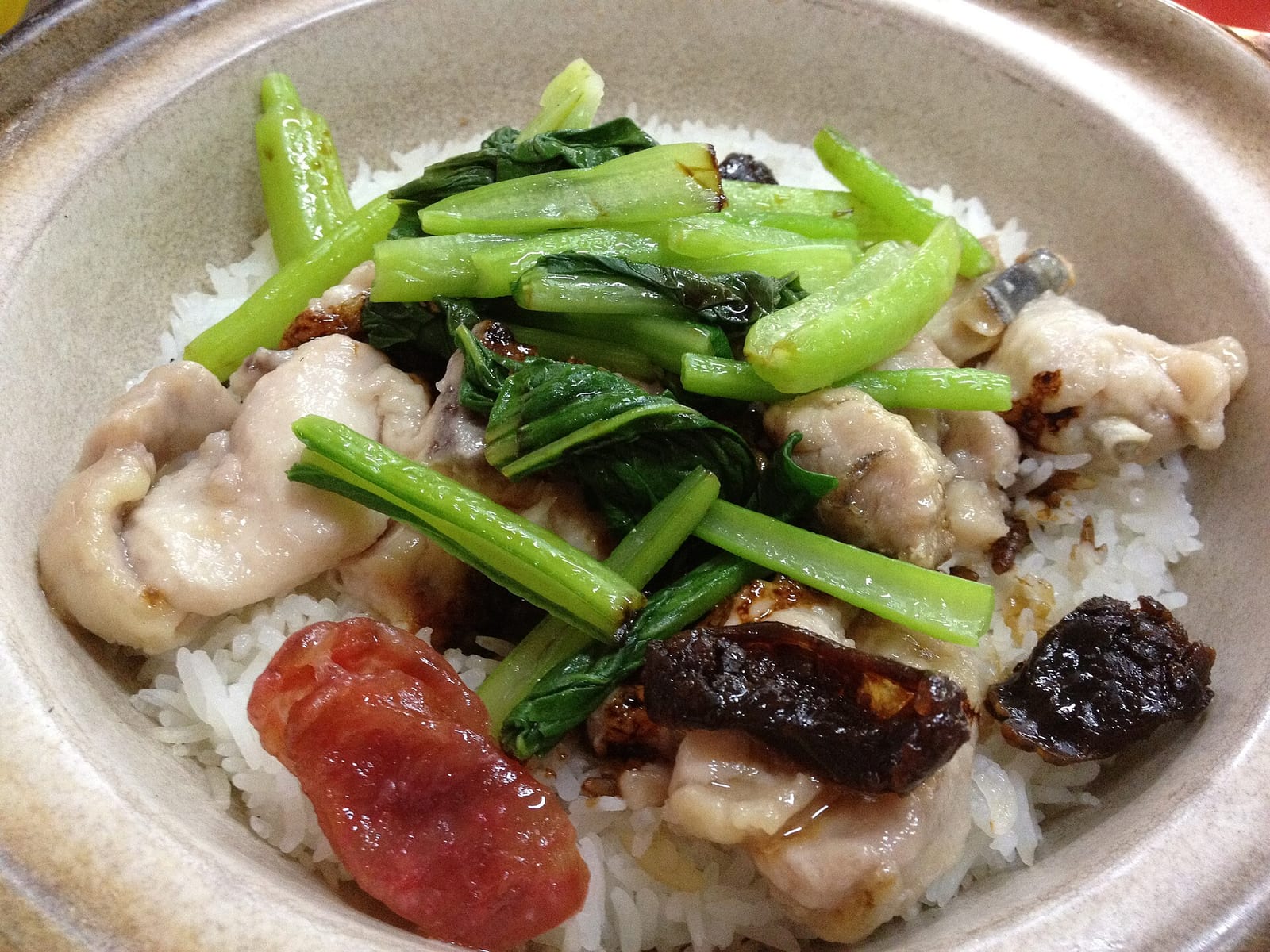
Claypot Rice砂煲饭
Rice cooked in the pot it is served in, lap cheong and salted fish laid on top, dark soy over everything — and the bottom crust is the whole point.
 03
03Rice & Chicken Rice·90 min·Beginner
Cantonese Congee广东粥
Rice broken down over an hour into a silken, bowl-clinging porridge, seasoned with century egg and slivered lean pork, ginger and white pepper — Chinatown's cure for everything.