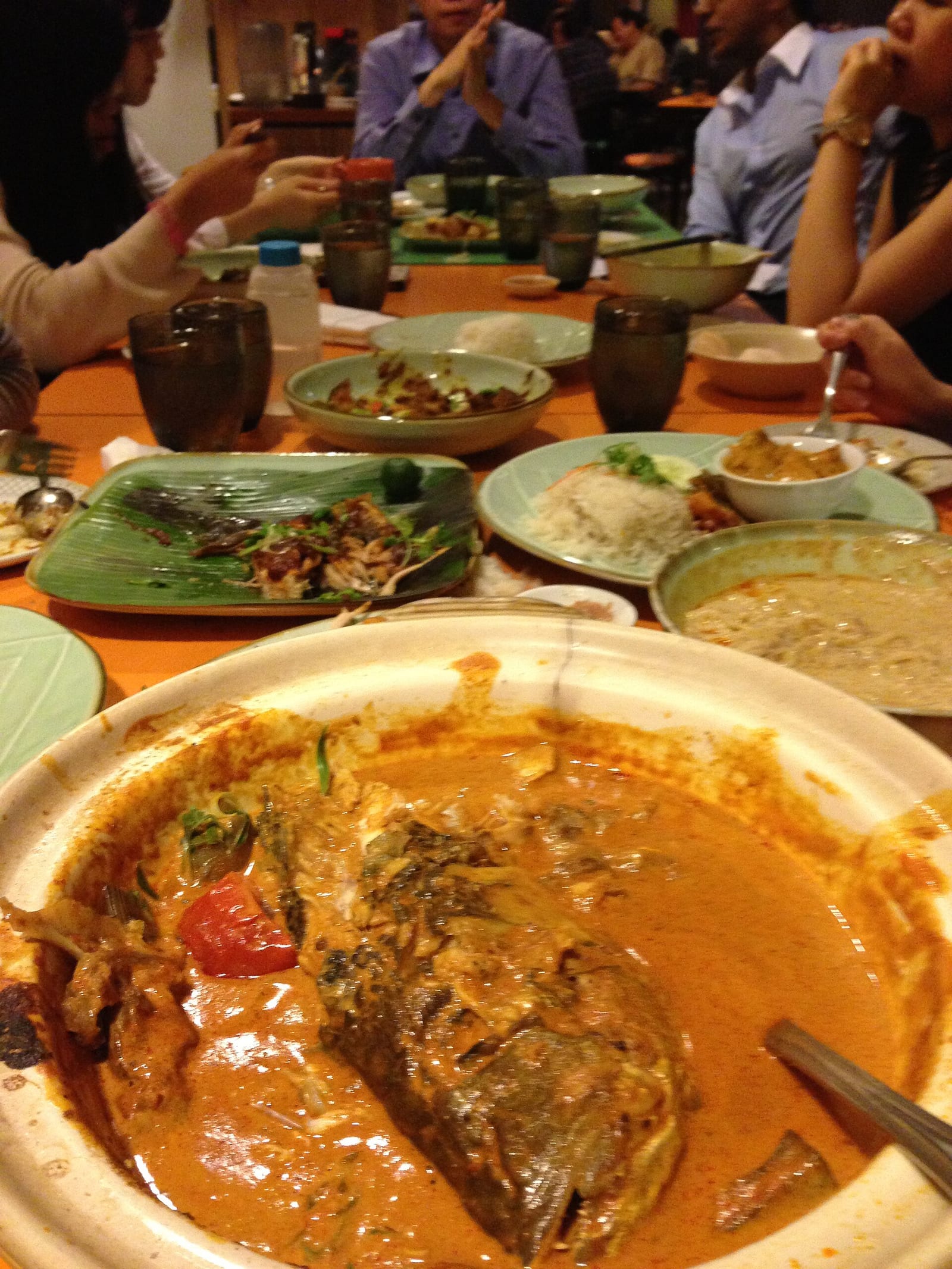
Fish Head Curry
மீன் தலை கறி
A whole snapper head simmered in a tamarind-sour, coconut-rich South Indian gravy with okra and brinjal — the dish Singapore invented in 1949 and no city else can claim.
By The Singaporean Recipes Kitchen · World Cookbook Series · July 13, 2026
Little India & TekkaPostwar & Merdeka, 1945–1965
No pork, no lard — as written.

- Prep
- 40 min
- Cook
- 45 min
- Serves
- 4
- Level
- Intermediate
Fish head curry is not an import. It did not arrive on a boat from Madras or a junk from Guangzhou; it was invented here, on this island, around 1949, by a cook named M.J. Gomez who had come from Kerala and set up in the young, hungry, postwar city. The story told is a merchant's story as much as a cook's: Gomez noticed that his Chinese customers already treated the fish head as the choicest part of the fish, the piece a family fought over, and he reasoned they would pay to eat it the way he knew how to cook it — split, and simmered in the tamarind-sour, coconut-rich gravy of the South Indian coast. He was right. The dish has been on the island's tables ever since.
What makes it worth telling straight is that it is genuinely two kitchens at once, and neither is decoration. The technique is Kerala to the bone: mustard seeds and fenugreek bloomed in hot oil, curry leaves crackling, tamarind for the sour spine, coconut milk stirred in at the end to round it. The subject — the whole head, cheeks and collar and the soft meat behind the eye — is Chinese reverence, the belief that the head holds the best eating on the fish. Put them together and you get something that exists in Singapore and, as far as anyone can honestly say, nowhere else. Other cooks have since claimed to have invented it first, and the claims can't all be true, but the fusion is the monument no matter whose hand struck the match.
Cook it and you learn why it survived. The gravy has to be built in layers a Malay rempah kitchen doesn't use — whole seeds tempered first, curry powder fried until its raw dust burns off, tamarind and coconut arriving at opposite ends to fight and then agree. The head itself asks only for patience and a gentle hand: poach it, never boil it, and read the eye rather than the clock. And because Gomez was cooking for everyone in a city still deciding what it was, the dish is halal as it stands — no pork, no lard, just fish and spice and the two communities that met over it.
A Kerala cook, a Chinese fish head, and a city that was inventing itself — 1949, and the island's most Singaporean dish was born from two kitchens at once.
Shiok (when it's exactly right) · A word from the kitchen
Ingredientsbahan-bahan
Serves
The fish
- 1red snapper or grouper head, about 800 g to 1 kg, split in halfask the fishmonger to halve it through the crown — you want the cheeks and collar, the sweetest meat on the fish
- 1 tspground turmeric
- 1 tspfine salt
The spice base
- 4 tbspfish curry powder (about 30 g)a South Indian blend heavy on coriander and chili, sold as "fish curry powder" — not the same as meat curry powder, which leans on more cinnamon and clove
- 6shallots, sliced
- 4garlic cloves, sliced
- 20 gginger, julienned (a thumb)
- 2sprigs fresh curry leaves, stripped
- 1 tspbrown mustard seeds
- 1/2 tspfenugreek seedsuse a light hand — fenugreek turns bitter fast, and this is the single seed that ruins the pot when doubled
- 3dried red chilies, snapped in half
The gravy
- 2 tbsptamarind pulp, soaked in 250 ml warm water and strained
- 400 mlcoconut milk (about 1 2/3 cups)the thick canned kind; stir it in off a hard boil or the fat splits and beads on the surface
- 300 mlwater (about 1 1/4 cups)
- 8okra (ladies fingers), tops trimmed but caps left onleave the stem cap intact so they don't leak their sticky insides and rope the gravy
- 1small brinjal (eggplant), cut into wedges
- 2tomatoes, quartered
- 3green chilies, slit lengthwise
- 3 tbspneutral oil
- 1 tspsugar
- 1 tspfine salt, or to taste
Methodcara masak
Step 1: Salt the fish and let it wait
Rub the split head all over with the turmeric and salt, working it into the gills and the cut face, and set it aside for 20 minutes. The turmeric firms the surface and takes the muddy edge off river fish; the salt starts seasoning meat that a fast simmer would otherwise leave bland at the bone. Pat it dry before it goes near the pot.
Step 2: Temper the seeds until they talk
Heat the oil in a wide pot or claypot over medium and drop in the mustard seeds. Wait for them to pop and skitter — 30 seconds — then add the fenugreek, dried chilies, and curry leaves and let them crackle for 10 seconds until fragrant. This is the South Indian move that a rempah-based kitchen skips, and it matters: whole seeds bloomed in hot oil carry a nuttiness the ground powder cannot, and they perfume the fat every later ingredient will cook in.
Step 3: Build the aromatic base
Add the shallots, garlic, and ginger and fry, stirring, 5 to 6 minutes until the shallots go soft and translucent and just start to gild at the edges. Stir the fish curry powder into a splash of the tamarind water to make a loose paste, then add it to the pot and fry 3 to 4 minutes until the raw, dusty smell of the powder lifts and the oil at the edge stains deep rust. Frying the powder is not optional — raw curry powder tastes chalky no matter how long the gravy simmers afterward.
Step 4: Simmer the gravy, then the vegetables
Pour in the remaining tamarind water and the plain water, bring to a gentle simmer, and add the brinjal wedges. Cook 5 minutes, then add the okra, tomatoes, and green chilies and simmer 5 more, until the brinjal is knife-tender and the okra is bright and just yielding. Season with the sugar and salt now — the gravy should read sharp with tamarind and savory, because the coconut milk is about to round it off.
Step 5: Lay in the fish head and poach it gently
Lower the fish head into the gravy cut-side down, spoon the liquid over it, cover, and poach at a bare simmer for 10 to 12 minutes. Do not stir it or boil it hard — a fish head is delicate at the collar and falls apart if bullied. It is done when the eye has turned opaque white and clouded, and the cheek meat flakes cleanly when you nudge it with a spoon. That eye is the honest doneness test the cheek can't give you from under the gravy.
Step 6: Finish with coconut milk, off the boil
Pull the pot back to the lowest heat, pour in the coconut milk, and warm it through for 2 to 3 minutes without letting it boil — a rolling boil splits coconut fat into greasy beads and turns a glossy gravy grainy. Taste and correct the balance: more tamarind for sharpness, more salt for depth, a pinch more sugar if the sourness bites. Rest it 10 minutes off the heat before serving; the gravy thickens and the flavors settle. Eat it with white rice, and know the cheeks and the gelatinous meat behind the eye are the prize the whole dish was built around.
Perkakas · The tools
Equipment
Claypot
sha baoFor claypot rice the pot IS the recipe — clay holds gentle heat, builds the crust, and comes to the table still ticking.
Shop on Amazon →Chinese cleaver
chai daoChops through a whole chicken for chicken rice, smashes ginger with the flat, scoops the lot into the wok. One blade, most of the canon.
Shop on Amazon →Granite mortar & pestle
lesung batuThe rempah tool. Pounding bruises and bleeds the aromatics in a way blades never do — the lesung is the sound of a Singapore kitchen starting dinner.
Shop on Amazon →
Equipment links are Amazon affiliate links. As an Amazon Associate we earn from qualifying purchases, at no cost to you. Disclosure.
Rate this recipe
Questions from the kitchen
Is fish head curry Indian or Chinese?
Neither, exactly, which is the whole point. It was invented in Singapore around 1949 by M.J. Gomez, a cook born in Kerala, who reasoned that his Chinese customers already prized the fish head as the best part of the fish and would pay for it dressed in a South Indian curry. So the technique — tempered seeds, curry leaves, tamarind, coconut — is Kerala, and the reverence for the head is Chinese, and the dish itself belongs to this island and nowhere else. Other cooks have claimed the invention since, told with the appropriate raised eyebrow, but Gomez is the name that stuck, and the fusion is the monument regardless of whose hand struck first.
My gravy turned grainy and greasy. What happened?
You boiled the coconut milk. Coconut fat is emulsified into the milk, and a hard boil breaks that emulsion — the fat separates into oily beads and the solids go grainy. Add the coconut milk at the very end, over the lowest heat, and warm it through without letting a single bubble break the surface. The same rule governs every coconut curry on this site.
Can I use fish fillets instead of a whole head?
You can, and on a weeknight nobody will stop you — but understand what you're trading. The head is the dish. Its cheeks, collar, and the gelatinous meat behind the eye give a silkiness and a depth of flavor no fillet carries, and the bones enrich the gravy as it poaches. Use thick, firm cuts like snapper or grouper steaks if you must, add them for the last 8 minutes only, and accept that you've made a very good fish curry rather than fish head curry.
Makan lagi · Cook next
Keep the burner on
 05
05The Indian-Muslim Table·300 min·Advanced
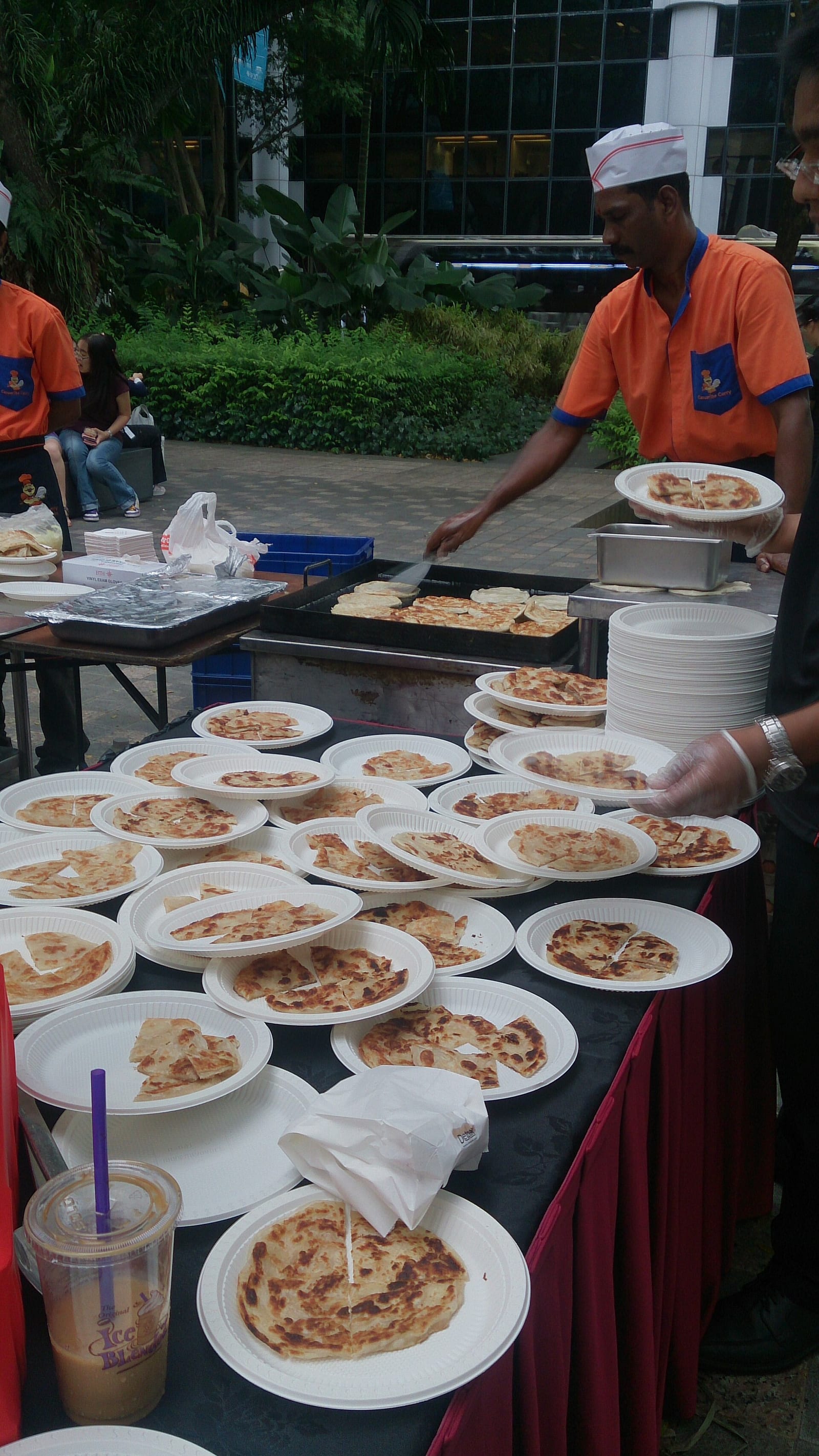
Roti Prataரொட்டி பிராட்டா
The Indian-Muslim griddle bread Singapore eats at 2 a.m. — ghee-rested dough stretched to tissue, folded, and fried until it shatters at the edges.
 05
05The Indian-Muslim Table·120 min·Advanced
Dum Biryaniதம் பிரியாணி
Long-grain basmati and spiced chicken sealed in one pot and cooked on its own steam — the Indian dum tradition, carried to Singapore through Little India's kitchens.
 05
05The Indian-Muslim Table·205 min·Advanced
Murtabakمرطبق · murtabak
Prata dough stretched glass-thin, folded over curried minced mutton and egg, griddled in ghee — the North Bridge Road classic rebuilt at home, fold by fold.